
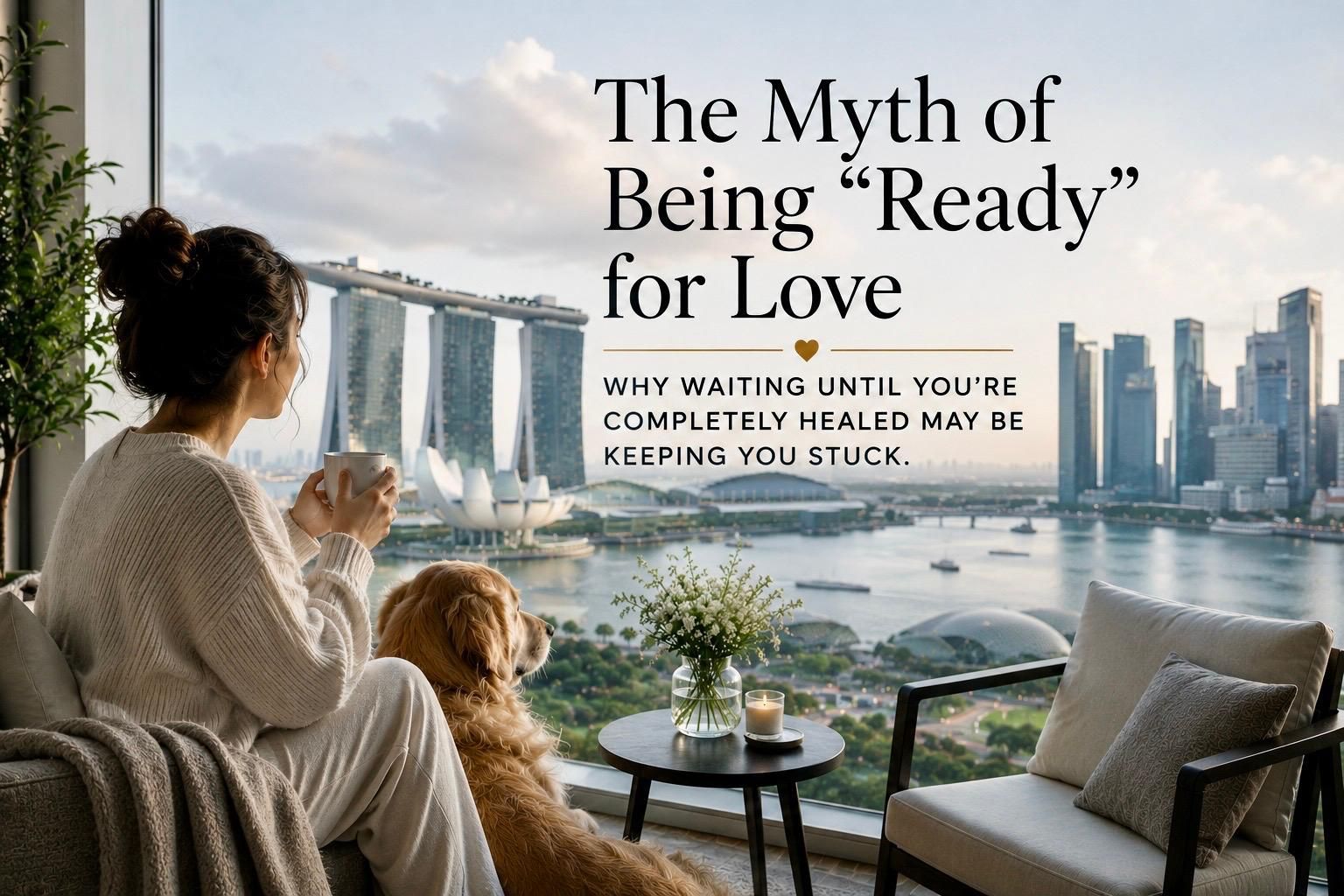
The Myth of Being "Ready" for Love
Six months after her breakup, my client Janice (not her real name) told me she wasn't ready to date.
At first, that didn't strike me as unusual. Breakups take time to recover from, and there is often wisdom and maturity in creating space to reflect before rushing into something new.
But as we spoke, it became clear that Janice wasn't simply taking time to heal. She was waiting to become a different person.
Since the breakup, she had immersed herself in self-development. She signed up for new sports, took on more responsibilities at work, read books on attachment theory, and spent countless hours trying to make sense of what the relationship had taught her. What began as a healthy desire to learn from the experience had gradually turned into a project with no clear endpoint.
"I still have work to do," she explained.
When I asked what would need to happen before she felt ready to date again, she described a version of herself who no longer became anxious if someone pulled away, no longer worried about rejection and no longer carried any emotional scars from past relationships.
Listening to her, I found myself wondering whether she was talking about healing at all. What she seemed to be describing was the absence of vulnerability.
After a painful breakup, it is easy to conclude that the safest path forward is to focus on ourselves. We tell ourselves that once we become more secure, more self-aware and less reactive, then we will be ready for a relationship. The underlying assumption is that love comes after healing.
It is hardly surprising that so many people believe this. We are constantly encouraged to "work on ourselves first" by social media, self-help content and well-meaning friends. Yet the more I thought about Janice's dilemma, the more I questioned whether we have misunderstood how healing actually works.
If relationships wound us, can they also heal us?
If we gathered some of the most influential psychologists of the last century into one room and asked whether people need to become fully healed before entering a relationship, many of them would challenge the premise of the question itself.
Not because healing is not important. Rather, because human beings do not heal in isolation as most imagine.
John Bowlby, the founder of Attachment Theory, spent much of his career studying the relationships that shape our emotional lives. Together with Mary Ainsworth's research, his work highlighted how our sense of safety, trust and belonging develops through our interactions with others.
This raises an interesting question. If some of our deepest insecurities were formed in relationships, can they be healed in isolation?
Insight certainly helps. Understanding why we fear abandonment, struggle with trust or become anxious in intimacy can be valuable. Therapy can help us connect the dots between our past and present. Self-reflection can increase awareness of patterns that previously operated outside our consciousness.
Yet there are some lessons that can only be learned through experience.
A person who fears abandonment does not simply need insight into where that fear came from. At some point, they need experiences that challenge the fear itself. They need to discover what it feels like when somebody stays, follows through and remains emotionally present. This is what attachment researchers mean when they talk about "earned security." We do not think our way into security. We gradually experience our way into it.
The parts of ourselves we only meet in relationships
Janice nodded when we discussed this, but she still looked worried.
"I understand that intellectually," she said, "but how can I be ready to date if I’m still feeling anxious?"
It is a fair question. After all, if old insecurities continue to surface, doesn't that mean more healing is needed?
Carl Jung might have offered a different perspective. He believed that relationships have a unique ability to reveal aspects of ourselves that remain hidden when we are alone. Much of what sits outside our awareness only becomes visible when it is activated.
Anyone can feel calm and secure when there is nobody close enough to disappoint them. Intimacy has a way of exposing fears, assumptions and vulnerabilities that otherwise remain hidden.
This can feel discouraging. Many people enter a new relationship only to discover that old insecurities reappear. They interpret this as evidence that they are not healed after all.
The truth is the appearance of fear is not always a sign that healing has failed or one has regressed. Sometimes it is a sign that healing has reached a layer that was previously inaccessible.
Healing as a Prerequisite
As our conversation continued, Janice arrived at something deeper: "Part of me feels like I must fix myself first."
I hear some version of this often in therapy. Not that people believe they are unlovable, but that they must become a much better version of themselves before they are ready for a relationship.
Carl Rogers who devoted much of his career to understanding what helps people to grow and flourish, observed that growth thrives in an atmosphere of acceptance rather than constant evaluation. Yet Janice had turned healing into a qualification process. The more she learned about attachment, boundaries and emotional health, the more criteria she seemed to create for herself.
The difficulty is that healing has no finish line. If complete healing is the standard for entering a relationship, many of us may spend years preparing for an exam that nobody ever passes.
Relationships are one of the places where healing happens
What strikes me is how many modern approaches arrive at similar conclusions despite speaking very different languages.
Daniel Siegel's work in interpersonal neurobiology demonstrates how our brains and nervous systems continue to develop through relationships. Jeffrey Young of Schema Therapy suggests that deeply held beliefs such as "I am unlovable" are rarely transformed through insight alone; they often require corrective emotional experiences that challenge old assumptions.
Even Acceptance and Commitment Therapy, which focuses heavily on psychological flexibility, would likely question the idea that we should wait until fear disappears before living our lives. One of its central messages is that meaningful action often comes before confidence, not after it.
Different theories yet they point toward the same possibility: relationships are not simply the reward we receive after healing. They are one of the places where healing happens.
Ready enough
Near the end of our work together, Janice rewrote the rule she had been living by. Instead of telling herself, "I need to heal before I date," she began experimenting with a different idea: "I can keep healing while I date."
On the surface, it sounds like a subtle shift in wording. Yet it reflects a fundamentally different understanding of how growth happens.
The myth of being “ready” for love assumes that healing and relationships happen sequentially and that we fix ourselves first and connect later. Yet Bowlby, Rogers, Jung and many others show us that human beings are shaped in relationships, discover themselves in relationships and often heal in relationships too. That involves entering a relationship with enough self-awareness to recognise our patterns, enough responsibility to own them, and enough curiosity to remain open despite the uncertainty that comes with caring deeply about another person.
As Donald Winnicott wrote, “It is a joy to be hidden, but disaster not to be found.” The goal is not to hide until all the work is done, but to keep growing while allowing ourselves to be seen.