The Importance of Fathers: Why You Should Be Involved

Dr. Glenn Graves, PhD
A man and a little girl are walking on the beach holding hands.

There is no shortage of statistics showing how important the role of father's is when it comes to raising happy and healthy children. But it seems that often, only mothers and their grown up kids are reading these articles. Dads! Wake Up! Read the good news about you.

In my counselling practice, I have been working with adults for years and with the passing years and my constant exploration with these adults, we invariably find ourselves sitting and talking to a child; their inner child, or we are revisiting the childhood in some way or another. It’s uncanny how many adults are stuck in some part of their childhood and when this happens, invariably a very influential parent is standing nearby in that scene or memory. They are there, either building up or tearing down the construct of self for that child. This can often get passed on in the form of an internal dialogue.


Internal dialogues can be positive or negative: judging, accessing, criticisms, encouragement, disapproval, rejecting and many more. They all have an impact.


This is why I am often finding myself going back to childhood with my clients. It's there, where they find many of the internal dialogues that are now dictating their actions.


In my couple's work, I often cite a well-known author John Gottman. He is world famous for his research on couples. However in recent months even Mr. Gottman and his wife are moving more towards work that is focused on parenting and the child experience. They have shifted because their own studies have highlighted the importance the parent's role plays in the child's healthy development and future relationships. Surprisingly their studies show that a father's role can be even more vital than at mothers in certain areas of development. No offense, Moms.


John and Julie Gottmans' studies have even gone so far as to shown that men and women are less likely to go to war when they have an involved father in their upbringing. "Fathers are probably the most important predictors of emotional development for sons and daughters," says Gottman, whose own research by the Bringing Baby Home program shows that when dads act as an emotion coach, by valuing and encouraging emotions, children are physically healthier, have fewer colds and illnesses, higher self-esteem and a strong sense of social connection. When dads communicate with their children about the emotions they are experiencing, behavioural problems decrease.


Since all emotions have a purpose, involved fathers attending to the emotions of their children, help the child to learn how to set boundaries to manage their experiences as well as how to respect the feelings of others which has shown to help increase mental, physical and social well-being.


Children with dads who are critical or dismissing of emotions are more likely to do poorly in school, fight more with friends and have poor health.


It's also known that children living in father absent homes are more likely to have emotional and behavioural problems, be suspended from school or drop out, be victims of child abuse or neglect, use drugs and commit suicide when in their teens. I even had a client recently say "No Dad is better than a bad Dad". I agree in part. Being critical and dismissive can cause more damage than not being there. But being present and positively participating, whether you have fathering skills or not, goes a long way to helping a child develop.


Parenting is an art like golf or speed texting on a BB while sipping a pint and negotiating mega deals. The craft can be honed only through more exposure to the experience. It can't just be learned from watching a movie. Although I do recommend It's a Wonderful Life and Pursuit of Happyness. Even golfers go to gurus to find out how to enter Zen on the 18th hole. So there is nothing wrong with seeking guidance from experts when it comes to the Do's and Don'ts in fathering.


Here are just a few to start with and you will probably recognize that many of them are common sense but rely on an intimate knowledge of the child in order to work. James Dobson in his book, How to Build Confidence In Your Child, writes, "The art of good parenting begins with the fundamental skill of seeing through the eyes of the child, of sharing the child's view of reality, feelings and hopes."


 Here are some common sense Do's and Don'ts: Try to picture each scenario through the eyes of your child.


  • Don't ask a question, demand an answer then talk before they have a chance to respond.
    "Should we have eggs for breakfast? I think it would be good for you. Let's have cereal for breakfast."
  • Don't attempt to scold them for one thing when you are angry about something else.
    "It's your fault I missed my important phone call. If you hadn't asked me that question I would have been paying attention."
  • Don't miss their appeals for a connection or affection.
    ”Daddy, can I have a hug?” “Not right now. Daddy's reading.”
  • Don't curse in anger. It's just scary and they miss the point.
    Self explanatory.
  • Don't look elsewhere when they are trying to speak to you.
    "Daddy, I had a question." "Yes dear." "Daddy." "Yes" ". I had a question." Yes dear, go ahead." "Daddy, can you look at me for a minute?"

  • Do as you say and as you do.
    "Daddy, you're here! " "I said I would make it for your school play. So I re-arranged my schedule."
  • Do spend time creating and playing with them.
  • "Let me show you a game I used to play with my father."
  • Do use empathetic listening with them; repeating what you understand about their expressed feelings.
    "When you complained about Daddy's job does that mean you miss me and want me to come home earlier?"
  • Do ask open ended questions when wanting to understand them better.
    "How did that make you feel when you heard Daddy shouting earlier?"
  • Do express love and affection.
    "Can I have a hug? I missed you."


We are models to our children. They learn through our example. They watch how we cope with problems and handle depression and handle infractions with others.


In psychology this is known simply as modelling. Children are the products of their subjective life experiences and these are in no small part comprised of what they observe in their parents.


We all know the declaration of not wanting to turn out like our parents, only to do just that. This means that a boy will be learning how to treat women in relationships in part, by his observation of how his father treats his mother: the way you talk to her and address her concerns and show interest in her needs.


The same man's daughter is also learning what to expect in her own relationships with men in the future. If its dysfunctional there is a likelihood that she can grown familiar with this and even find the dysfunction more comfortable, since she has already learned from her mother, and father, how to navigate in that environment.


Pay attention to the modelling that you are doing in all aspects of your role as father. It's a privilege to be a father, and I assure you that the privilege will be all yours when you are watching your young ones walk gracefully and happily into their own adult lives.


About the Author: Dr. Glenn Graves is an American psychologist who has lived and worked in Asia since 2004. The founder and director of Counseling Perspective, Glenn has nearly two decades of experience in providing counselling support to local and expatriate individuals, couples, and families in Singapore. His specialities include child counselling and trauma recovery. Read Full Bio >

By Esther Oon-Bybjerg June 17, 2026
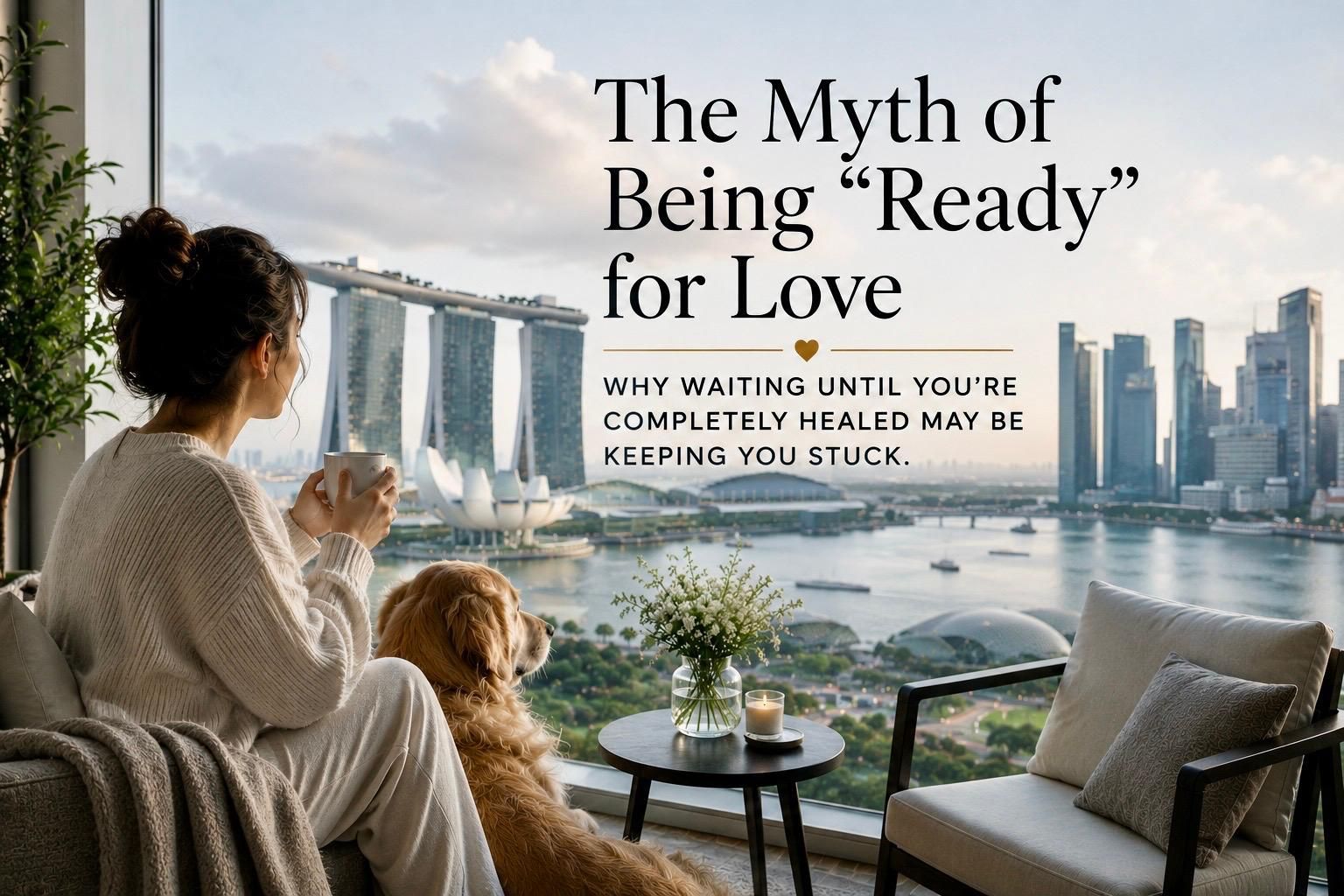
Six months after her breakup, my client Janice (not her real name) told me she wasn't ready to date. At first, that didn't strike me as unusual. Breakups take time to recover from, and there is often wisdom and maturity in creating space to reflect before rushing into something new. But as we spoke, it became clear that Janice wasn't simply taking time to heal. She was waiting to become a different person. Since the breakup, she had immersed herself in self-development. She signed up for new sports, took on more responsibilities at work, read books on attachment theory, and spent countless hours trying to make sense of what the relationship had taught her. What began as a healthy desire to learn from the experience had gradually turned into a project with no clear endpoint. "I still have work to do," she explained. When I asked what would need to happen before she felt ready to date again, she described a version of herself who no longer became anxious if someone pulled away, no longer worried about rejection and no longer carried any emotional scars from past relationships. Listening to her, I found myself wondering whether she was talking about healing at all. What she seemed to be describing was the absence of vulnerability. After a painful breakup, it is easy to conclude that the safest path forward is to focus on ourselves. We tell ourselves that once we become more secure, more self-aware and less reactive, then we will be ready for a relationship. The underlying assumption is that love comes after healing. It is hardly surprising that so many people believe this. We are constantly encouraged to "work on ourselves first" by social media, self-help content and well-meaning friends. Yet the more I thought about Janice's dilemma, the more I questioned whether we have misunderstood how healing actually works. If relationships wound us, can they also heal us? If we gathered some of the most influential psychologists of the last century into one room and asked whether people need to become fully healed before entering a relationship, many of them would challenge the premise of the question itself. Not because healing is not important. Rather, because human beings do not heal in isolation as most imagine. John Bowlby, the founder of Attachment Theory, spent much of his career studying the relationships that shape our emotional lives. Together with Mary Ainsworth's research, his work highlighted how our sense of safety, trust and belonging develops through our interactions with others. This raises an interesting question. If some of our deepest insecurities were formed in relationships, can they be healed in isolation? Insight certainly helps. Understanding why we fear abandonment, struggle with trust or become anxious in intimacy can be valuable. Therapy can help us connect the dots between our past and present. Self-reflection can increase awareness of patterns that previously operated outside our consciousness. Yet there are some lessons that can only be learned through experience. A person who fears abandonment does not simply need insight into where that fear came from. At some point, they need experiences that challenge the fear itself. They need to discover what it feels like when somebody stays, follows through and remains emotionally present. This is what attachment researchers mean when they talk about "earned security." We do not think our way into security. We gradually experience our way into it. The parts of ourselves we only meet in relationships Janice nodded when we discussed this, but she still looked worried. "I understand that intellectually," she said, "but how can I be ready to date if I’m still feeling anxious?" It is a fair question. After all, if old insecurities continue to surface, doesn't that mean more healing is needed? Carl Jung might have offered a different perspective. He believed that relationships have a unique ability to reveal aspects of ourselves that remain hidden when we are alone. Much of what sits outside our awareness only becomes visible when it is activated. Anyone can feel calm and secure when there is nobody close enough to disappoint them. Intimacy has a way of exposing fears, assumptions and vulnerabilities that otherwise remain hidden. This can feel discouraging. Many people enter a new relationship only to discover that old insecurities reappear. They interpret this as evidence that they are not healed after all. The truth is the appearance of fear is not always a sign that healing has failed or one has regressed. Sometimes it is a sign that healing has reached a layer that was previously inaccessible. Healing as a Prerequisite As our conversation continued, Janice arrived at something deeper: "Part of me feels like I must fix myself first." I hear some version of this often in therapy. Not that people believe they are unlovable, but that they must become a much better version of themselves before they are ready for a relationship. Carl Rogers who devoted much of his career to understanding what helps people to grow and flourish, observed that growth thrives in an atmosphere of acceptance rather than constant evaluation. Yet Janice had turned healing into a qualification process. The more she learned about attachment, boundaries and emotional health, the more criteria she seemed to create for herself. The difficulty is that healing has no finish line. If complete healing is the standard for entering a relationship, many of us may spend years preparing for an exam that nobody ever passes. Relationships are one of the places where healing happens What strikes me is how many modern approaches arrive at similar conclusions despite speaking very different languages. Daniel Siegel's work in interpersonal neurobiology demonstrates how our brains and nervous systems continue to develop through relationships. Jeffrey Young of Schema Therapy suggests that deeply held beliefs such as "I am unlovable" are rarely transformed through insight alone; they often require corrective emotional experiences that challenge old assumptions. Even Acceptance and Commitment Therapy, which focuses heavily on psychological flexibility, would likely question the idea that we should wait until fear disappears before living our lives. One of its central messages is that meaningful action often comes before confidence, not after it. Different theories yet they point toward the same possibility: relationships are not simply the reward we receive after healing. They are one of the places where healing happens. Ready enough Near the end of our work together, Janice rewrote the rule she had been living by. Instead of telling herself, "I need to heal before I date," she began experimenting with a different idea: "I can keep healing while I date." On the surface, it sounds like a subtle shift in wording. Yet it reflects a fundamentally different understanding of how growth happens. The myth of being “ready” for love assumes that healing and relationships happen sequentially and that we fix ourselves first and connect later. Yet Bowlby, Rogers, Jung and many others show us that human beings are shaped in relationships, discover themselves in relationships and often heal in relationships too. That involves entering a relationship with enough self-awareness to recognise our patterns, enough responsibility to own them, and enough curiosity to remain open despite the uncertainty that comes with caring deeply about another person. As Donald Winnicott wrote, “It is a joy to be hidden, but disaster not to be found.” The goal is not to hide until all the work is done, but to keep growing while allowing ourselves to be seen. 
By Aki Tsukui - Director of Wellness / Leadership & Systemic Coach June 2, 2026
In today’s performance-driven world, identity is often shaped by what we do, how we deliver, and how we are perceived. We become known for our roles, our output, our ability to keep going.But beneath this constructed identity lies a quieter question: Am I living and leading as a whole human being? This is where the conversation on identity begins to shift from definition to integration. The Hidden Cost of Fragmentation Many individuals move through their professional lives in subtle disconnection. The mind is engaged - analyzing, solving, producing. The body is overridden - pushing through fatigue and tension. Emotions are managed or suppressed. And a deeper sense of purpose is often left out entirely. Over time, this fragmentation accumulates. It begins to show up as fatigue, reduced clarity, emotional depletion, or a gradual sense of disengagement. In more visible forms, it is named as burnout. As this experience becomes widespread, it calls for a different understanding. Burnout is no longer best seen as an individual issue. It is a signal of accumulated strain, and often, of how work systems are designed around disconnection. This is what is opening new conversations in leadership today. A Reframing of the Conversation In a recent workshop. The Workplace Reset, with leaders and HR professionals, a different kind of dialogue began to emerge. Instead of asking, “How do we fix burnout?”, the question deepened: What are we asking of people and from which parts of themselves are they operating? There was a clear shift. Burnout began to be seen as organizational feedback, not personal failure. Wellbeing moved from a benefit to a foundation for performance. And resilience was reframed: not as silent endurance, but as the ability to stay connected while navigating challenges. At the heart of these reflections was a simple realization: People do not show up to work in parts. They show up as whole human beings. The Four Dimensions of Being To understand identity more fully, we must recognize the dimensions that shape our experience: • Mind — thoughts, logic, and sense-making • Body — physical state and lived experience • Emotion — inner and relational world • Spirit — values, purpose, and alignment When these operate in isolation, we may still function but often at a cost. Clarity becomes forced. Energy becomes depleted. Decisions feel misaligned. But when these dimensions integrate, something shifts. There is steadiness. Clarity becomes more natural. And a sense of coherence emerges in how we think, feel, and act. This is not about adding more. It is about reconnecting what has been separated. Identity as a Felt Experience Identity is often approached as something we define intellectually through titles or strengths. But true identity is not something we arrive at through thinking alone. It is something we experience . It is felt when actions align with values. When the body is not in resistance to the pace we keep. When emotions are acknowledged rather than suppressed. When work connects to meaning. The body plays a crucial role here. It holds signals the mind may override: tension, fatigue, ease. These are not inconveniences, but information. When we begin to listen, not just cognitively, but somatically, we access a more honest relationship with ourselves. From that place, identity becomes less about performance, and more about alignment. Embodied Leadership This shift toward integration is especially relevant in leadership. Traditional leadership has emphasized control, decisiveness, and cognitive strength. While important, these are no longer sufficient on their own. What is needed is embodied leadership . The capacity to lead from internal coherence. To stay grounded under pressure. To acknowledge emotions without being overwhelmed. To think clearly without disconnecting from intuition. To act in alignment with values, not just expectations. Leaders who operate this way shape environments. Where people feel safe enough to be honest. Where challenges can be named. Where wellbeing supports performance. In such spaces, people are not required to fragment themselves to succeed. They are able to show up more fully and contribute more meaningfully. Integration as Practice Integration is not a one-time insight. It is an ongoing practice. It requires pause withinmovement. Awareness within action. And the willingness to notice when we are out of alignmentand return. This may look like: • Checking in with the body, not just the mind • Noticing emotions without suppressing them • Creating small moments of stillness • Reflecting on whether decisions feel aligned These simple practices begin to shift how we relate to ourselves and our work. Harmony, Not Perfection Integration does not mean being perfectly balanced. Harmony is dynamic. There are moments when the mind leads, and moments when the body needs rest. Times when emotions surface, and times when purpose provides direction. The key is not control, but connection. To remain in relationship with all parts of ourselves and trust the intelligence within that allows us to respond with coherence. This is where resilience takes on a new meaning: Not endurance without struggle, but the ability to stay connected while moving through it. A New Way Forward As organizations navigate increasing complexity, there is an opportunity to redefine what it means to perform and to lead. Not through further optimization of parts but through integration of the whole. Because the most sustainable way of working is not built on pushing harder. It is built on coherence. On creating conditions—within individuals and systems—where people do not have to disconnect in order to function. Where identity is not something we perform, but something we live. And where, in returning to wholeness, we unlock not only wellbeing but a deeper, more grounded form of leadership.
By Ines Palomera June 2, 2026
Every year, Pride Month invites us to celebrate LGBTQ+ identities, communities, histories, and the people who came before us. Yet beyond the colours, visibility, and public celebrations, Pride also invites us into a deeper reflection: what does it mean to belong to ourselves? What does it mean to be seen, not only by the world around us, but by the people we love, the communities we live in, and the systems that shape our everyday lives? From a marriage and family therapy perspective, identity is never formed in isolation. We do not simply wake up one day with a complete understanding of who we are. We become ourselves through relationships. We are shaped by our families, cultures, religions, languages, gender expectations, friendships, migration stories, and the places we learn to call home. For many of us, identity is not one single answer, but rather a collection of many parts of ourselves trying to coexist. This is especially true in a city like Singapore. Singapore is a place where so many cultures, religions, languages, and ways of being exist side by side. There is something deeply precious about walking through a city where people express themselves through food, dress, language, faith, family traditions, and community rituals in so many different ways. In that diversity, we are reminded that identity is layered. We are not only one thing. We may be queer, Singaporean, foreign-born, religious, spiritual, neurodivergent, multilingual, a parent, a partner, a child, a professional, a caregiver, or all of these at once. And yet, for LGBTQ+ individuals, couples, and families, the experience of identity can also carry tension. In Singapore, meaningful progress has been made. The repeal of Section 377A marked an important step in the journey toward greater dignity and recognition. At the same time, many LGBTQ+ people continue to live with the reality that not all relationships, families, and identities are fully recognised or protected in the same way. Both truths can exist together: we can honour the progress that has been made, while also acknowledging the battles that are still being fought. Pride, then, is not only about celebration. It is also about resilience. It is about the courage to name oneself honestly in a world that may not always make that easy . It is about the quiet strength of a young person trying to understand their gender or sexuality. It is about the couple who builds a life together even when their relationship is not always seen by the law. It is about the parent who chooses love over fear. It is about the friend who listens without judgment. It is about the family member who is still learning, but chooses to remain present . It is about the communities that create spaces where people do not have to shrink themselves to be accepted. A few weeks ago, I had the chance to attend an anniversary event at Proud Spaces, a community space in Singapore that brings together LGBTQ+ people, allies, and organisations. What stayed with me was not only the event itself, but the feeling of being in a room where people were actively building belonging. These spaces do not appear by accident. They are created by people who give their time, energy, care, advocacy, and often their own lived experience so that others may feel less alone. Spaces like these matter because tolerance is not the same as belonging. To be tolerated is to be allowed to exist. To belong is to feel that your existence has a place . It is to walk into a room and feel that you do not need to hide the parts of yourself that make others uncomfortable. It is to be able to speak, dress, love, move, pray, parent, and live with a sense of dignity. In therapy, we often see how painful it can be when parts of a person’s identity have been silenced for too long. Shame does not only live inside individuals; it is often created and sustained in relationships and systems. When someone repeatedly receives the message that a part of them is too much, too different, too inconvenient, or too difficult to understand, they may begin to disconnect from themselves. Healing often begins when that person is met differently: with curiosity, validation, safety, and respect. This is why Pride Month is relevant to all of us, whether we identify as LGBTQ+ or not. Pride asks us to reflect on the spaces we create. Are we making room for people to be honest about who they are? Are we listening when someone tells us their name, their pronouns, their story, their family structure, their faith, their culture, or their fears? Are we allowing the people around us to be complex, or are we asking them to fit into categories that feel more comfortable for us? It also asks us to turn inward. Which parts of ourselves have we learned to hide? Which parts have we been taught to minimise? Where do we feel most whole? Who are the people, communities, and spaces that allow us to breathe more freely? For some, Pride may be loud and visible. For others, it may be private and quiet. It may look like attending a community event, wearing something that feels true, holding a partner’s hand, coming out to one trusted person, reconnecting with chosen family, or simply looking at oneself with a little less shame than before. We stand on the shoulders of those who fought before us, and we continue that work in the way we show up for one another today. In Singapore, more and more spaces are being created for people to feel validated in their identities, relationships, cultures, beliefs, and ways of being. These spaces matter because belonging is not built only through laws or public recognition, but also through the everyday experience of being met with care, curiosity, and respect .  At Counseling Perspective, we have worked hard to reflect this same spirit within our own team. Our counsellors bring together a multitude of backgrounds, cultures, beliefs, origins, and specialisations, allowing us to support people whose stories, identities, and needs may look very different from one another . Whatever your story, it has a place with us. If you are exploring your identity, struggling with your sense of belonging, or simply needing a space where you can feel more fully seen, our team is here to walk alongside you and help you find the emotional support that feels right for you. Resources in Singapore For those looking for LGBTQ+ affirming community spaces, support, or further information, the following organisations may be helpful: · Proud Spaces — A community space for LGBTQ+ people, allies, and organisations in Singapore, focused on connection, collaboration, and belonging. Visit website · Oogachaga — An LGBTQ+ affirming community-based organisation offering counselling, emotional support, and professional resources. Visit website · Oogachaga WhatsApp Counselling — A free and confidential WhatsApp counselling service for LGBTQ+ people in Singapore. Visit website · The T Project — Singapore’s first and only social service for the transgender community, including shelter and community support. Visit website Sayoni — A Singapore-based feminist organisation advocating for queer women, including lesbian, bisexual, transgender, and queer women.